
Before our ingredients reach you, they already carry a story!
From side-streams to shipment: building a fully circular delivery system
At ÄIO, we develop sustainable fats and oils through fermentation, transforming low-value side-streams from the wood and agricultural industries into high-performance ingredients. And sustainability does not end at production, it extends to how we deliver our products to partners around the world.
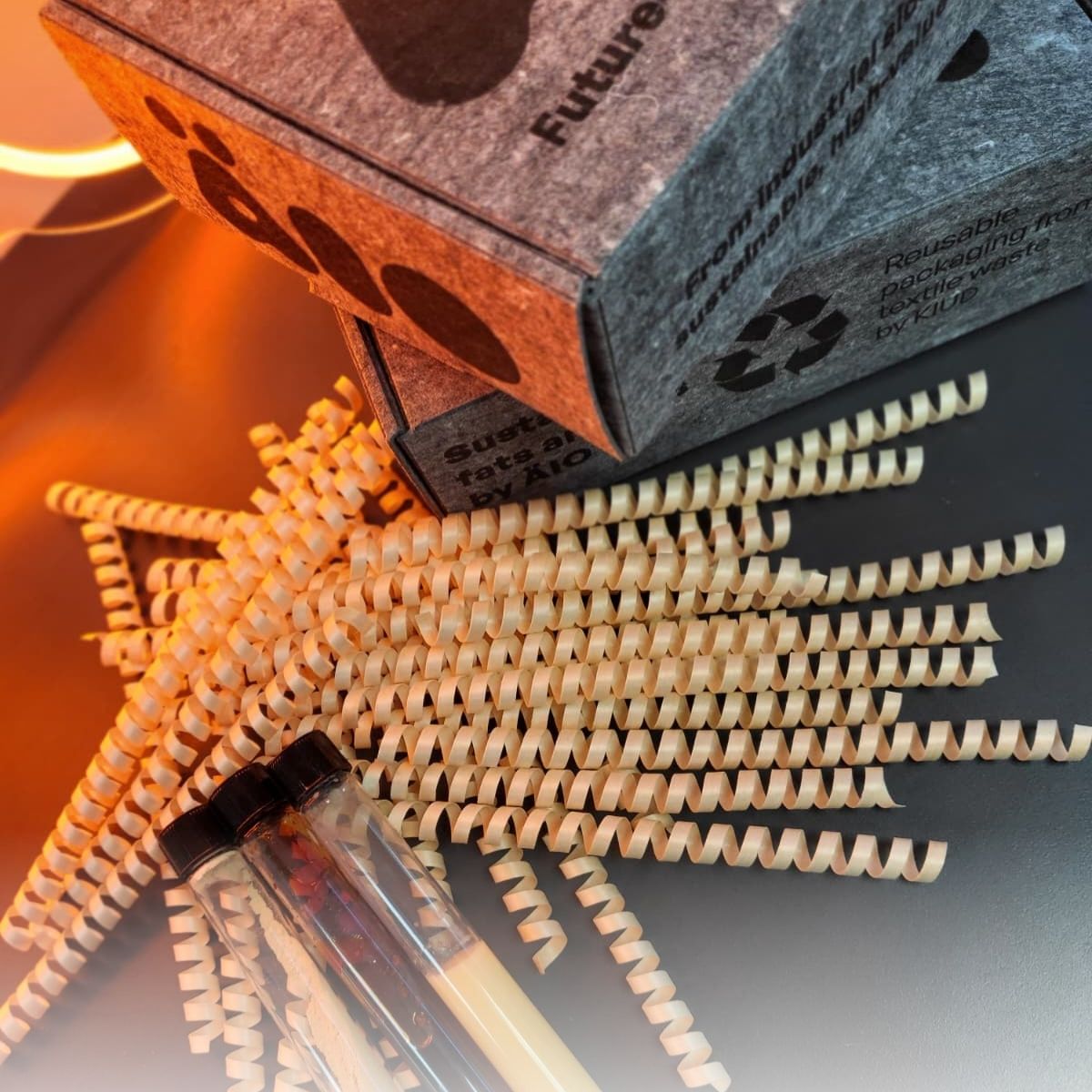
When sending samples for testing, we asked a critical question: Can the packaging system reflect the same circular principles as the ingredients inside? Conventional packaging relies heavily on single-use cardboard and plastic-based protective materials. While widely used, these systems are resource-intensive and generate significant waste. For a company built on circularity, this creates a mismatch. Extending this thinking to packaging was a natural next step.
ÄIO’s production process already achieves:
- up to 97% less land use compared to palm oil production
- around 90% less water use compared to agricultural oil production
- 10x faster production cycles than traditional oil crops
Packaging material innovation: KIUD and RAIKU
To create a packaging system aligned with ÄIO values, we partnered with two Estonian startup companies innovating at the material level.
KIUD: Replacing cardboard with textile waste
In the EU alone, over 10 million tonnes of textile waste and 34 million tonnes of cardboard packaging waste are generated annually. KIUD addresses both challenges by converting textile waste into durable, reusable packaging.
Compared to conventional cardboard solutions:
- up to 82% lower CO₂ footprint
- reusable structure instead of single-use lifecycle
- valorisation of an underutilised waste stream
“We see packaging as a resource, not waste. By transforming textile leftovers into reusable solutions, we extend material life cycles and reduce the need for virgin resources.” says KIUD team.
RAIKU: high-performance protection with minimal resources
Inside the packaging, ÄIO uses RAIKU’s wood-based protective material, designed to replace plastic foams and paper fillers.
RAIKU’s patented structure enables:
- 3000x less water usage compared to traditional paper processes
- 50x less energy consumption
- 10x less wood usage
- 0 chemicals used in production
Additionally, 1 m³ of wood can produce up to 20 m³ of packaging material, the material is 100% natural and compostable and production processes generate no harmful emissions. “Our goal is to rethink protective packaging from the ground up using minimal resources while achieving maximum performance and eliminating harmful processes.” RAIKU team says.
While KIUD, RAIKU, and ÄIO operate in different domains, the underlying principle is the same: Valorise what already exists.
- ÄIO: side-streams to fats and oils
- KIUD: textile waste to reusable packaging
- RAIKU: wood to highly efficient protective material
This creates a fully aligned system where waste streams are re-integrated into value chains, resource use is minimized at every step and functional performance meets industrial standards. “At ÄIO, we are not only building sustainable ingredients, we are building systems. From feedstock to final delivery, every step is an opportunity to reduce impact and rethink how materials are used,” Nemailla Bonturi, CEO & Co-founder of ÄIO.
ÄIO collaborates with partners across the world. Each sample shipment is not only a delivery of ingredients but also a demonstration of a scalable, circular system in practice. The future of sustainable industry will not be defined by single innovations, but by how systems connect raw materials, production processes, packaging, logistics. By aligning these elements, companies can move from incremental improvements to system-level transformation.
Every ÄIO sample package reflects this approach, from fermentation-derived ingredients to circular packaging solutions. We continue to work with partners to test, validate, and scale next-generation fats and oils.
Interested in testing ÄIO ingredients?
Request a sample and experience the system in action.