ÄIO Featured in Protein Production Technology: Where will the world’s fats come from?

While alternative proteins have dominated the conversation around food innovation over the past decade, fats are equally essential. They define taste, texture, mouthfeel, functionality, and nutrition. Yet they are often overlooked.
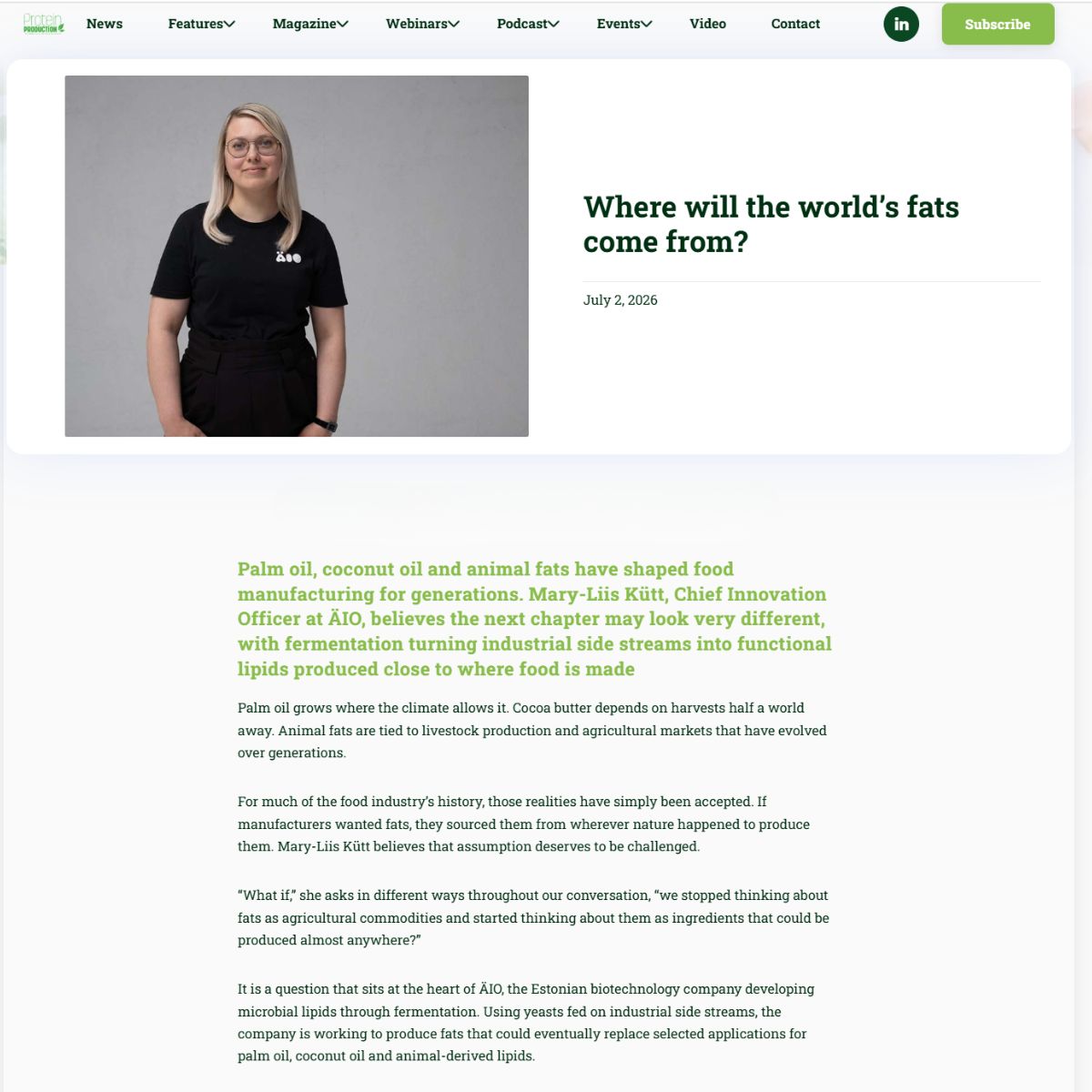
We’re pleased to share that our Chief Innovation Officer, Dr. Mary-Liis Kütt, was recently interviewed by Nick Bradley and featured in Protein Production Technology International (PPTI), one of the leading publications covering the global protein and food technology industries. The interview explores one of the industry’s most important questions: Where will the world’s fats come from?

Looking beyond traditional oils

For generations, food manufacturers have relied on palm oil, coconut oil, cocoa butter, and animal fats. These ingredients have shaped the global food industry, but they also face increasing challenges related to climate, land use, biodiversity, supply chain resilience, and geopolitical uncertainty. The article explores how precision fermentation offers an alternative approach, producing functional lipids from microorganisms fed with industrial side streams rather than agricultural crops.

Instead of asking where suitable land is available, fermentation allows us to ask a different question: What if fats could be produced wherever sustainable feedstocks already exist? This shift has the potential to fundamentally change how and where food ingredients are manufactured.

Why fats matter?

Consumers often associate food innovation with protein. However, anyone developing foods knows that protein alone does not create a great eating experience. As Dr. Mary-Liis Kütt explains in the interview:

“Consumers have started to understand that protein alone cannot make the miracle. To achieve good taste and a juicy texture, you also need fats.”

Fats contribute far more than calories. Developing more sustainable fats therefore becomes just as important as developing alternative proteins. Fats influence:

  • mouthfeel and creaminess,
  • juiciness,
  • flavour release,
  • texture,
  • processing performance,
  • nutritional profile.

A conversation about the future

For ÄIO, participating in discussions like this is an opportunity to broaden the conversation around food innovation.

Dr. Mary-Liis Kütt reflects:

“For decades, we have accepted that fats must come from plantations or livestock. Precision fermentation allows us to rethink that assumption. By producing lipids from locally available side streams, we have an opportunity to build food systems that are more resilient, more circular, and less dependent on finite natural resources. We believe the future of fats will be defined not only by what they are made of, but also by where and how they are produced.”

We are proud to see this conversation featured in Protein Production Technology International and look forward to continuing to work with partners across the food industry to build the next generation of sustainable fats and oils.

Read the full interview in Protein Production Technology International: Where will the world’s fats come from?

ÄIO Featured in FoodTech Japan (Foovo): Sharing Our Vision

We’re excited to share that our story has been featured by FoodTech Japan (Foovo), one of Japan’s leading media platforms covering food technology, precision fermentation, and sustainable innovation. In an extensive interview, our CEO and Co-founder, Dr. Nemailla Bonturi, discusses... Read more

ÄIO’s research featured in EURO COSMETICS magazine: Exploring the Future of Fermentation-Derived Cosmetic Oils

ÄIO’s  Head of Cosmetics Development, Dr. Magdalena Koziol, has published a technical article in the April issue (4/2026) of EURO COSMETICS, one of Europe’s leading trade magazines for the cosmetics and personal care industry. The article, “Fermentation-Derived Oils: A Biotechnological... Read more

From thesis to technology: celebrating ÄIO’s new graduates

This year, we are proud to celebrate three members of our team who have reached an important milestone in their academic journey while already helping to build the future of sustainable fats and oils. Research that doesn’t stay on the... Read more