
From hectares to bioreactors: why the future of fats and oils needs a new production model
The world is running out of natural fats.
Demand for fats and oils continues to grow across food, cosmetics, household products, and industrial applications. By 2032, the global fats and oils market is expected to reach more than $350 billion. At the same time, agriculture already uses around 44% of the world’s habitable land, while climate change, biodiversity loss, geopolitical instability, and population growth continue putting pressure on global supply chains. The question is no longer if the fats and oils industry will need to change. The question is when.
At ÄIO, we believe the future of fats and oils cannot rely only on expanding agricultural production. Instead of producing oils from hectares of farmland, we produce them from microorganisms inside bioreactors. From hectares to bioreactors.
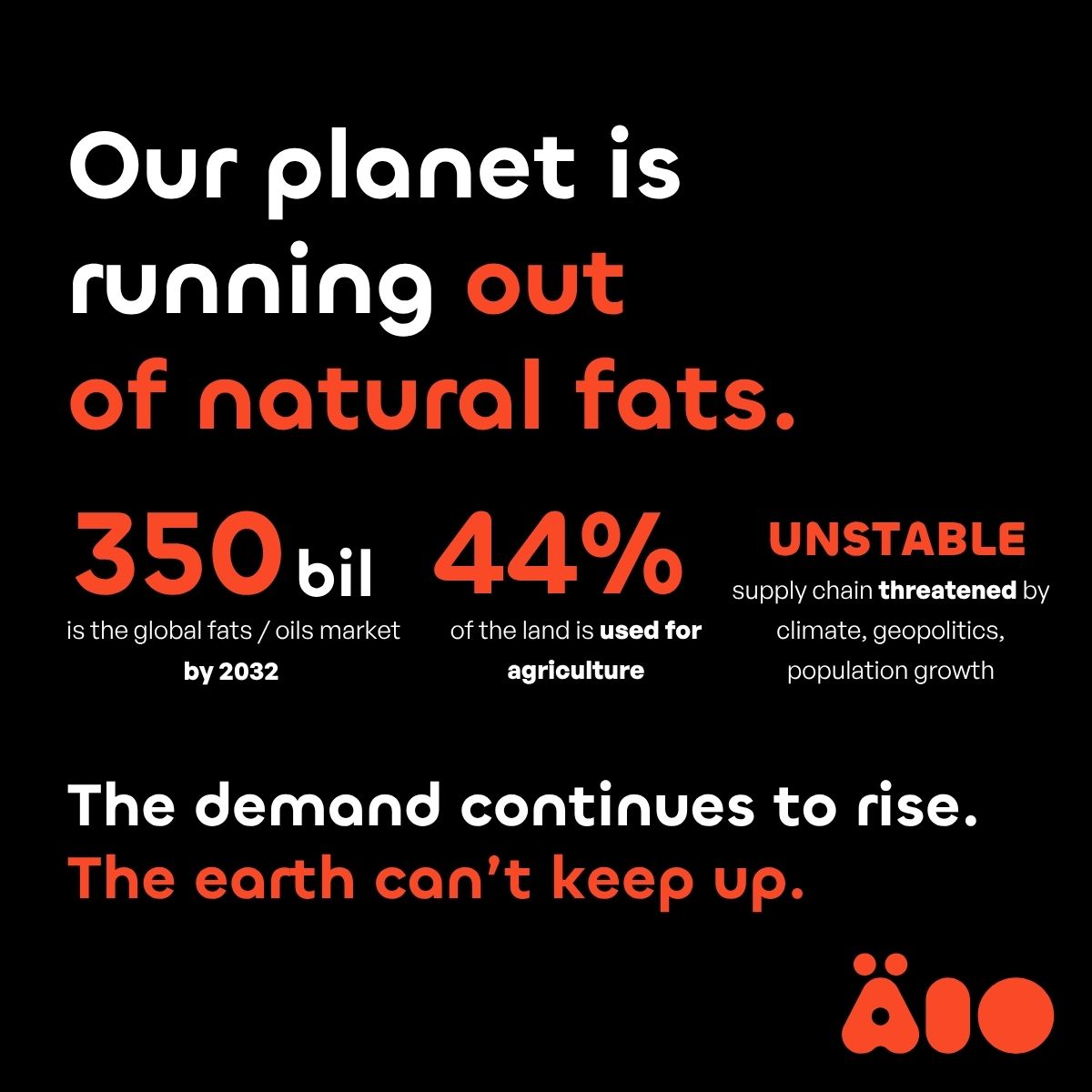
The world’s fats and oils market situation in 2026
Why measuring sustainability matters
As industries increasingly search for alternatives to conventional oils such as palm oil, coconut oil, and animal fats, sustainability claims alone are no longer enough. Companies, investors, regulators, and consumers want measurable proof. This is where Life Cycle Assessment (LCA) becomes important. But what is LCA?
LCA is an internationally recognised scientific method used to evaluate the environmental impact of a product throughout its life cycle. It measures factors such as:
- carbon emissions
- land use
- water consumption
- energy demand
- resource depletion
Today, LCA has become one of the most important tools for understanding the true environmental footprint of ingredients and industrial systems. For industries like cosmetics and food, LCA data is increasingly becoming a requirement. Companies use it to support ESG reporting, reduce Scope 3 emissions, improve procurement decisions, strengthen sustainability claims, and avoid greenwashing. In short: sustainability is becoming measurable.
What makes ÄIO different?
ÄIO develops fermentation-derived fats and oils from low-value side-streams from the food, agricultural, and wood industries. Using proprietary yeast strains, we transform underutilised biomass into high-performance oils and fats for cosmetics, food, and industrial applications. Unlike conventional agriculture-based production, fermentation allows production in controlled systems independent of climate, tropical land use, or seasonal variability. This changes the equation completely. Instead of relying on massive agricultural areas, production happens in bioreactors using significantly fewer natural resources.
What does ÄIO’s LCA show?
Our latest Life Cycle Assessment results for Encapsulated oil show strong environmental improvements compared to conventional vegetable oils:
- 41% less CO₂ (3.98 vs 6.7 kg CO₂e/kg)
- 95% less land (0.3 vs 5.62 m² per kg)
- 94% less water (0.09 vs 1.5 m³ water-eq)
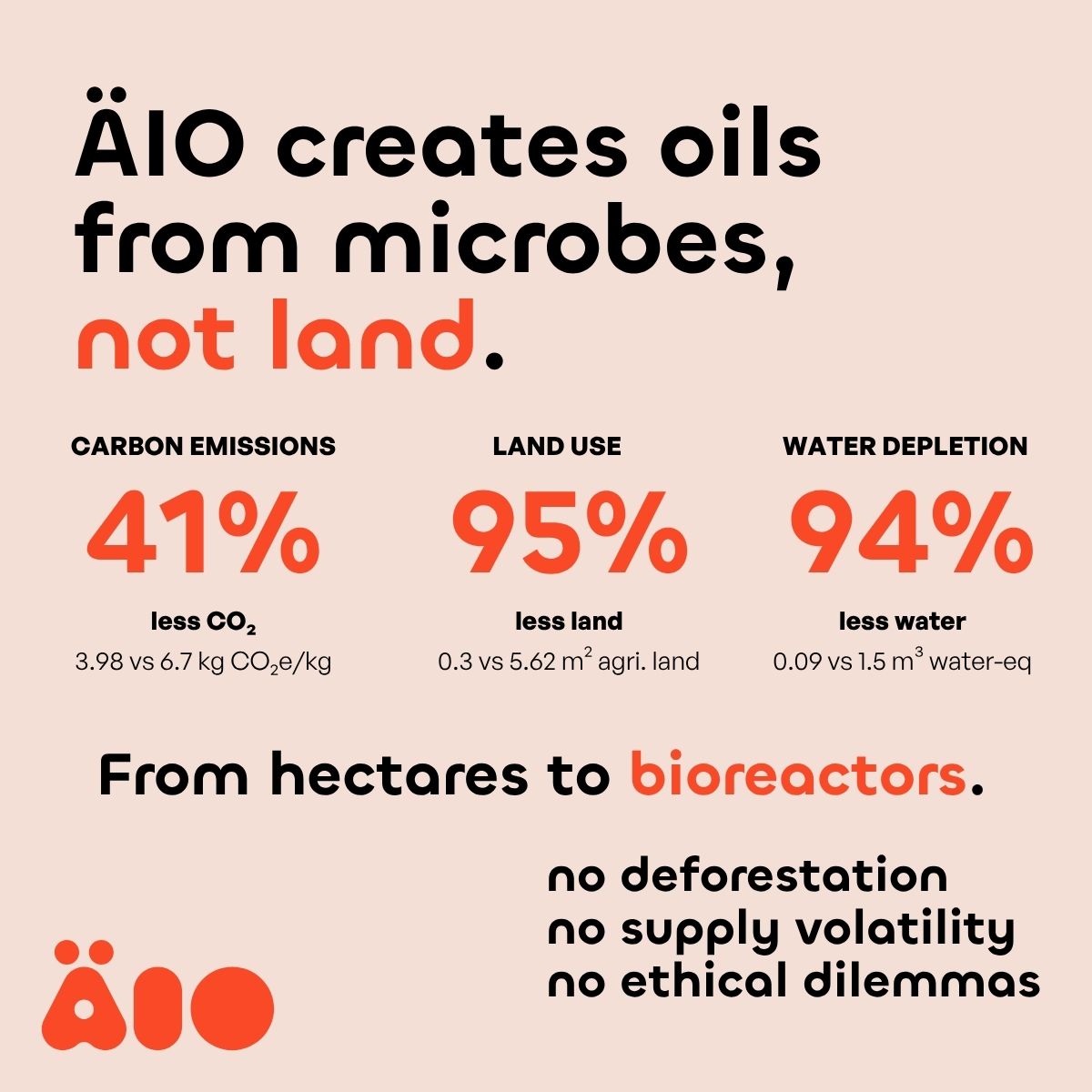
ÄIO’ Encapsulated oil LCA numbers
The comparison becomes even more powerful when looking at land use directly. Conventional vegetable oils require approximately 5.62 m² of agricultural land per kilogram of product. ÄIO’s process at commercial scale has the potential to reduce this to around 0.3 m². Water use shows a similarly significant reduction: 0.09 m³ water-equivalent compared to 1.5 m³ in conventional vegetable oil production.
And importantly, our modelling shows that environmental performance improves further as production scales.
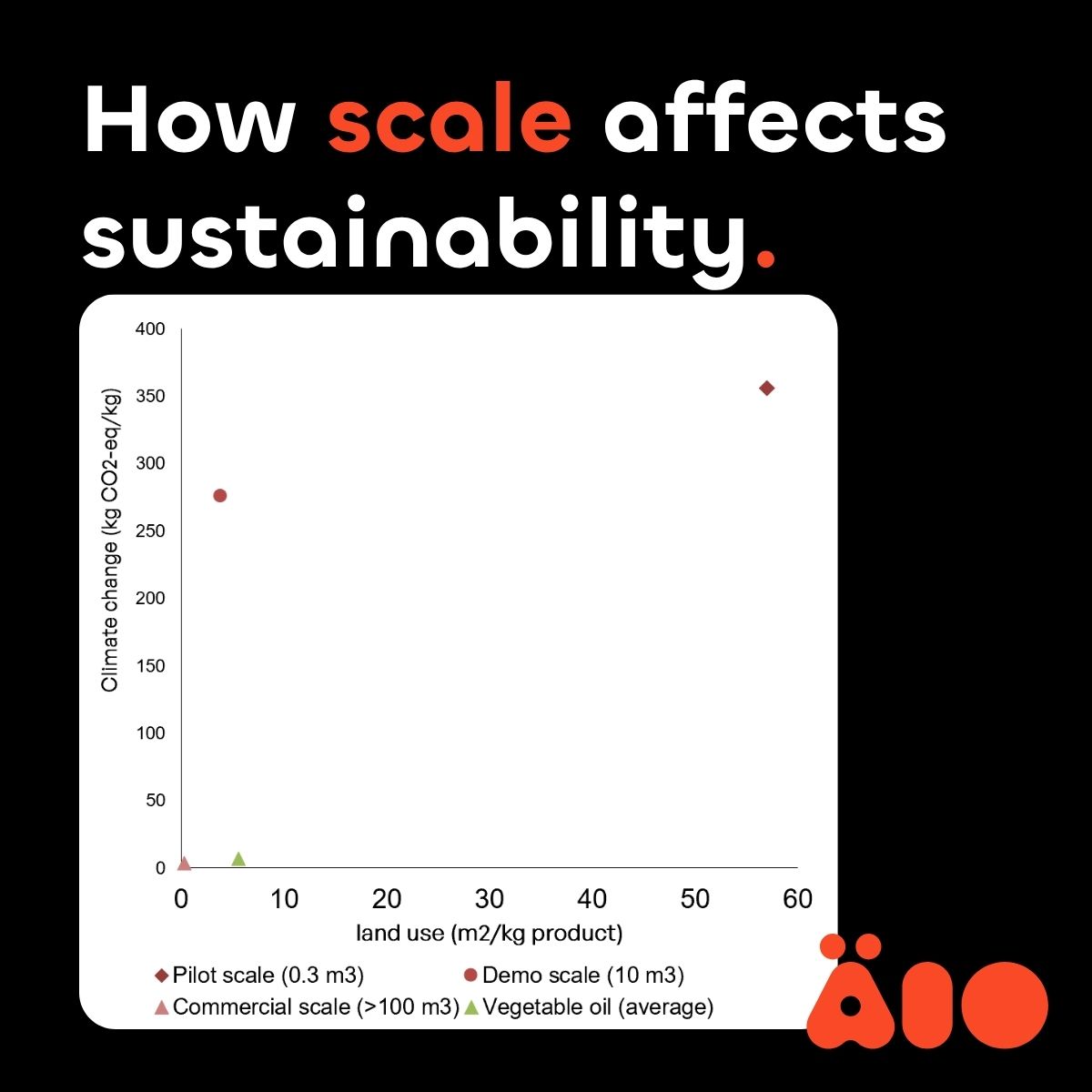
ÄIO’ LCA graph in 2026
As we move from pilot scale to demo and industrial scale, land use and climate impact continue to decrease significantly. This is critical because scalability is often one of the biggest questions around emerging technologies. Our data suggests fermentation becomes increasingly resource-efficient at larger scale.
Why this matters globally
The importance of these numbers goes beyond sustainability reporting. Reducing land use by 95% means reducing pressure on forests, biodiversity, and agricultural expansion. Reducing water depletion means lower dependency on increasingly stressed natural resources. Producing oils in controlled fermentation systems also creates more resilient supply chains, less vulnerable to droughts, crop failures, geopolitical instability, and climate-related disruption. For industries increasingly searching for traceable, climate-resilient, and deforestation-free ingredients, this creates a fundamentally different production model.
No deforestation.
No supply volatility.
No ethical dilemmas tied to agricultural expansion.
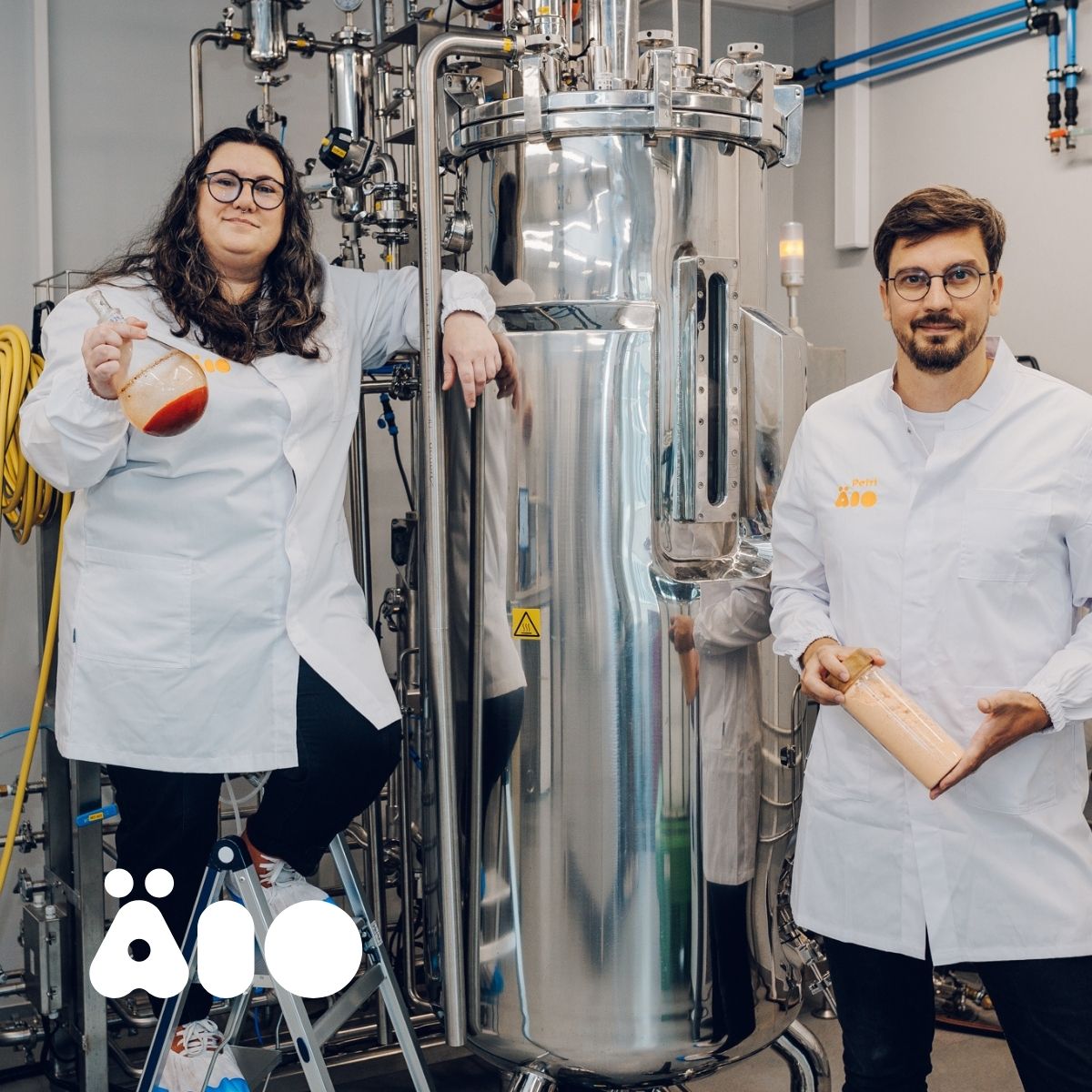
ÄIO Co-founders: Dr. Nemailla Bonturi and Professor Petri-Jaan Lahtvee
A new generation of fats and oils
For decades, the world has relied on agriculture as the primary way of producing fats and oils. Biotechnology now offers another path. At ÄIO, we believe fermentation is not simply an alternative production method, it is part of a larger industrial transformation already happening across food, chemicals, materials, and cosmetics. The future of fats and oils is no longer limited by hectares of land. It can be designed in bioreactors. And increasingly, measured through real environmental data.