
Building ÄIO: why scaling fermentation requires more than great science
Interview with Martin Mets, Chief Financial & Product Officer at ÄIO.
When people hear about biotechnology, they often think about scientific discoveries, breakthrough ingredients and fermentation tanks. What they rarely see is everything required to transform those discoveries into a commercially successful business. Developing a new ingredient is only the beginning. Bringing it to market requires manufacturing, regulatory readiness, partnerships, customers, financial planning and long-term investment. Unlike software startups, deeptech companies cannot simply launch a product overnight. Industrial biotechnology takes years of scientific development, pilot production, engineering and scale-up before reaching significant commercial volumes.
ÄIO has now entered a new stage of that journey. Its first cosmetic ingredients are commercially available, active sales have started, a global distribution network is being built and more than 40 partners are evaluating ÄIO ingredients in technical and commercial formulations. The company prepares raising Series A to take the next major step: scaling commercial manufacturing and proving the economics of fermentation-derived fats and oils at significantly larger volumes.
So why does a biotechnology company raise substantial capital even after its first products have reached the market? We spoke with Martin Mets, ÄIO’s Chief Financial and Product Officer, about scaling biotechnology, building a resilient business and why fermentation could fundamentally transform the global fats and oils industry.
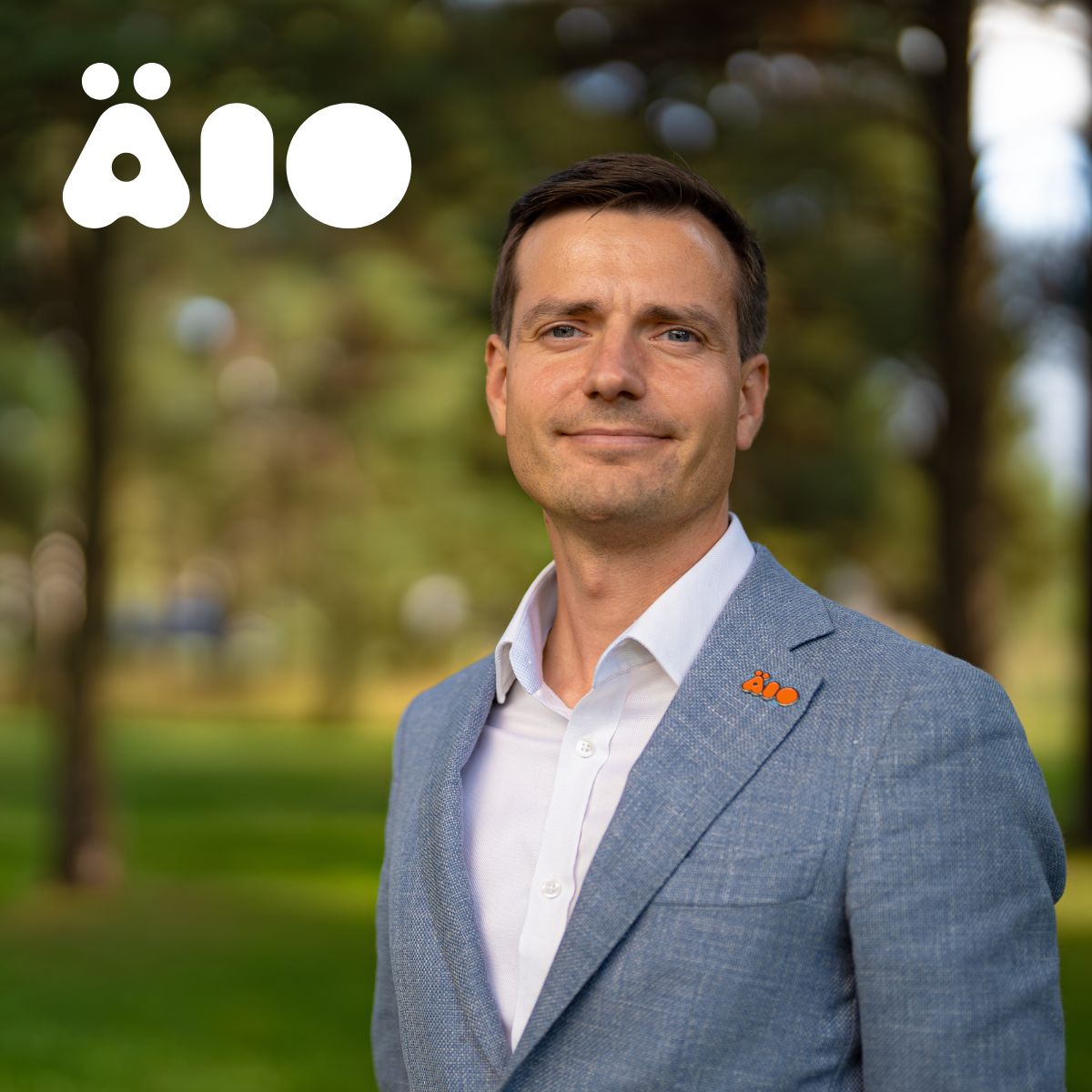
1. Why do biotechnology startups raise significant capital before becoming profitable?
Martin: Building industrial biotechnology is fundamentally different from building software. Before commercial revenues can scale, we need to validate the technology, demonstrate production at industrially relevant scale, secure manufacturing partnerships and build reliable supply chains. Investment allows us to accelerate that journey and our next funding round will help us expand our commercial production capacity, continue reducing production costs, grow sales and develop the technology for new product launches and next stages of industrial scale-up. The goal is to demonstrate a repeatable business model supported by customers, revenues, commercially profitable production economics and proven technology.
2. What convinced you that ÄIO has the potential to become a globally significant company?
Martin: The answer starts with a simple problem. A very large proportion of the world’s usable land is already dedicated to agriculture, while global demand for fats and oils continues to grow. If we continue expanding agricultural production at historical rates, the pressure on land, ecosystems and natural habitats becomes increasingly difficult to sustain. This is even without mentioning the havoc climate change will likely cause many agricultural regions and their production supply chains. New supply sources are needed and fermentation offers one pathway to scale production with a fraction of the land requirements of conventional agriculture, while reducing dependence on climate, seasonality and geographically concentrated agricultural supply chains. It is not simply about replacing one ingredient with another, it’s about creating an entirely new way of producing some of the world’s most important raw materials.
3. How large is the opportunity?
Martin: The global fats and oils market is around $350 billion and continues to grow. These materials are fundamental inputs across food, personal care, home care and numerous industrial applications. Beauty and personal care alone represent a substantial opportunity, but our long-term ambition extends far beyond one industry. That is important from an investment perspective because we are not trying to create demand for an entirely new category, the demand already exists and the opportunity is to develop better ways of producing ingredients that global industries already need.
4. What makes fermentation economically attractive?
Martin: People often associate fermentation primarily with sustainability and it is certainly important, but the long-term advantages are much broader. Fermentation enables production closer to customers using locally available feedstocks rather than relying exclusively on agricultural plantations concentrated in specific parts of the world. It can reduce exposure to climate variability, geopolitical disruption and seasonal harvests while creating greater manufacturing flexibility. Another major advantage is the technology platform itself as ÄIO isn’t developing only one oil, our lipid technology platform can be used to develop different fatty acid profiles and products for different applications and markets. That flexibility is fundamentally different from agriculture and you cannot change what a plantation produces according to next year’s market demand. ÄIO’s technological platform enables a technological leap from high variability agricultural process to a controlled industrial manufacturing process, with much higher economic and ecological efficiency. This step change in underlying manufacturing platform has huge planetary and financial value and ÄIO is determined to be the leading tech provider for this revolution.
5. Investors often worry about production costs. How does ÄIO approach this challenge?
Martin: Cost competitiveness is one of our biggest priorities. Every improvement in strain engineering, fermentation efficiency, downstream processing, feedstocks and manufacturing scale contributes to reducing production costs and we have already demonstrated more than 100x reduction in production costs since ÄIO was founded. Our current roadmap shows how further improvements in strain engineering, production processes, lower-cost feedstocks and increasing production scale can continue pushing costs down and scale itself has a significant effect. Larger facilities improve equipment and labour efficiency driving higher capital productivity. Our modelling shows a pathway from specialty and premium ingredients towards increasingly large commodity markets as production costs decrease. That is why we look at the cost curve and not only today’s production cost as the final economics of the technology.
6. What do investors look for when evaluating a company like ÄIO?
Martin: Technology alone is never enough and investors are looking for three things:
- first, an exceptional team with proprietary know-how
- second, strong technical validation demonstrating that the technology works and can be developed further to realize the long term vision
- third, customers willing to adopt the products
When those three elements come together, biotechnology moves from scientific promise towards commercial reality and for ÄIO, we can increasingly demonstrate all three. We have developed a proprietary fermentation and strain-engineering platform, scaled production significantly from our early laboratory work, commercially launched our first cosmetic ingredients and are now seeing those ingredients move through customer evaluation and formulation pipelines towards store shelves.
7. What role do partnerships play in scaling biotechnology?
Martin: Partnerships are essential because a single company cannot transform global supply chains alone. Customers validate market needs and manufacturing partners accelerate scale-up, distributors provide access to regional customers and formulation expertise, engineering partners help design efficient production facilities and strategic industry partners can help us develop entirely new products and applications while lowering commercial and financial risks. ÄIO has already signed distribution agreements covering multiple international markets, while additional negotiations are ongoing. More than 40 partners are currently in technical evaluation or commercial formulation with our ingredients. Every successful partnership reduces one part of the risks involved in widespread roll-out of the technology.
8. ÄIO has commercialised its first products. Why did you start with cosmetics?
Martin: Commercialisation is one of the most important stages for any deeptech company because it proves that years of research can create real value for customers. Cosmetics is an ideal first market for ÄIO, with strong market size and high openness to innovation. It offers a faster route to market than food while rewarding innovation, performance and differentiated ingredient functionality. Our cosmetic portfolio includes Fermira™ RedOil, ZymaLipid Complex and Encapsulated oil. The ingredients are commercially available and supported by our growing international distributor network. Active sales have started, partners are formulating with our ingredients and the first end products containing ÄIO ingredients have entered the market. So we are no longer talking only about what the technology could do, we demonstrate what customers are actually willing to buy.
ÄIO’s product roadmap also expands into food and other lipid categories as regulatory approvals, technology development and production economics enable us to address increasingly larger markets.
9. How does ÄIO build confidence in its science and technology?
Martin: Great biotechnology starts with great science, but a commercially successful biotechnology company needs much more than one scientific breakthrough. At ÄIO, we have built a multidisciplinary team covering strain engineering, synthetic biology, fermentation, downstream processing, product development, analytical chemistry, quality and commercialisation. Every ingredient goes through extensive analytical review, performance testing and continuous optimisation before reaching customers. And research does not stop once a product launches, it continues throughout the product lifecycle as we improve performance, manufacturing efficiency and future generations of ingredients. We have also successfully secured competitive national and European research funding, and these grants allow us to continue ambitious R&D programme alongside commercial development, work with scientific and industrial partners and reduce some of the technological risk associated with developing completely new production methods.
10. What needs to happen next for ÄIO?
Martin: The next major milestone is expanding our commercial production to satisfy rapidly growing demand and launching new products to the market. We will continue deepening our existing commercial markets and building our global distribution reach to increase the impact of our products and the scale of our manufacturing. Our current scale-up strategy is deliberately capital-efficient. Rather than immediately building a large factory ourselves, we will use contract manufacturing and strategic production partnerships as we move through successive production scales. The current roadmap moves from tens of tonnes towards hundreds and soon thousands of tonnes of annual production. At each stage, the technology becomes more efficient, the addressable market expands and another layer of scale-up risk is removed.
11. What does the next investment round need to prove?
Martin: Series A is an important milestone because it connects commercial demand with production scale. We have already moved from technology development into proving product-market fit, the next phase is about scaling that traction: expanding production, growing revenues, additional commercial products and continued improvement of our production economics. Our investor roadmap is milestone-driven where commercial revenues and product expansion support the next production scale, while greater scale improves economics and opens larger market segments. Ultimately, we want to demonstrate that fermentation-derived lipids are not simply technically possible or environmentally attractive, but that are a cutting edge industrial manufacturing platform.
12. What excites you most about working at ÄIO?
Martin: The opportunity to rethink one of humanity’s oldest industries. For thousands of years, we have relied primarily on agriculture as the source of fats and oils (among other basic ingredients) and biotechnology now gives us the opportunity to produce many of those materials differently. I often compare it with energy. For example, we no longer need to grow a tree, cut it down and burn it to access the solar energy stored inside it. Today we can capture that energy directly through solar panels and I believe fermentation represents a similar shift for many of the raw materials we use every day, direct, sustainable, decentralized and highly efficient way to produce the desired outcome through technology.
About Martin Mets
Martin Mets is Chief Financial and Product Officer at ÄIO. Before joining the company, he spent more than fifteen years in finance, investment strategy and product development, including leadership roles at LHV and Trigon Capital. At ÄIO, Martin combines financial modelling, commercial strategy and product development to help scale fermentation-derived specialty fats and oils from scientific innovation into a global business.