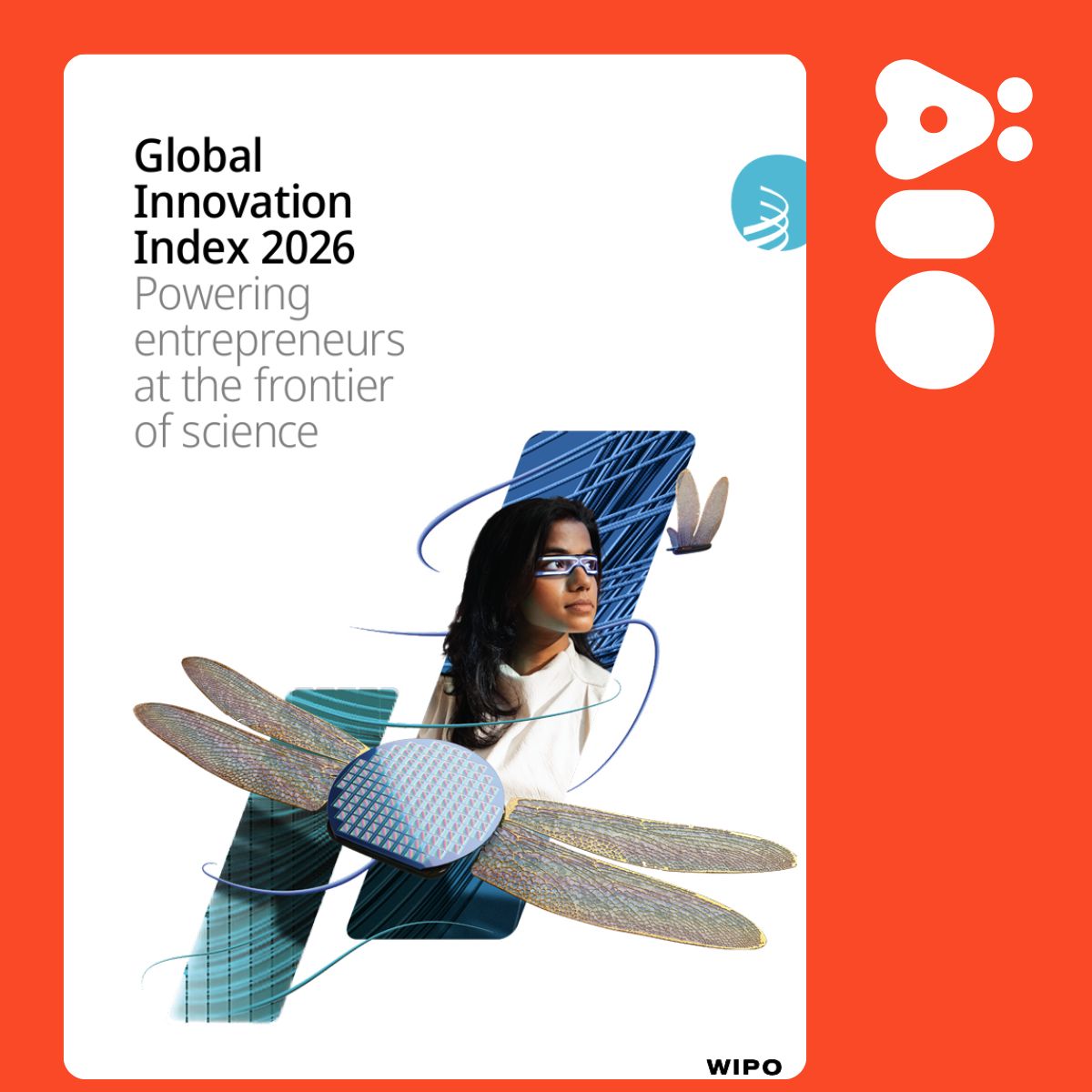
WIPO Highlights ÄIO in the Global Innovation Index 2026
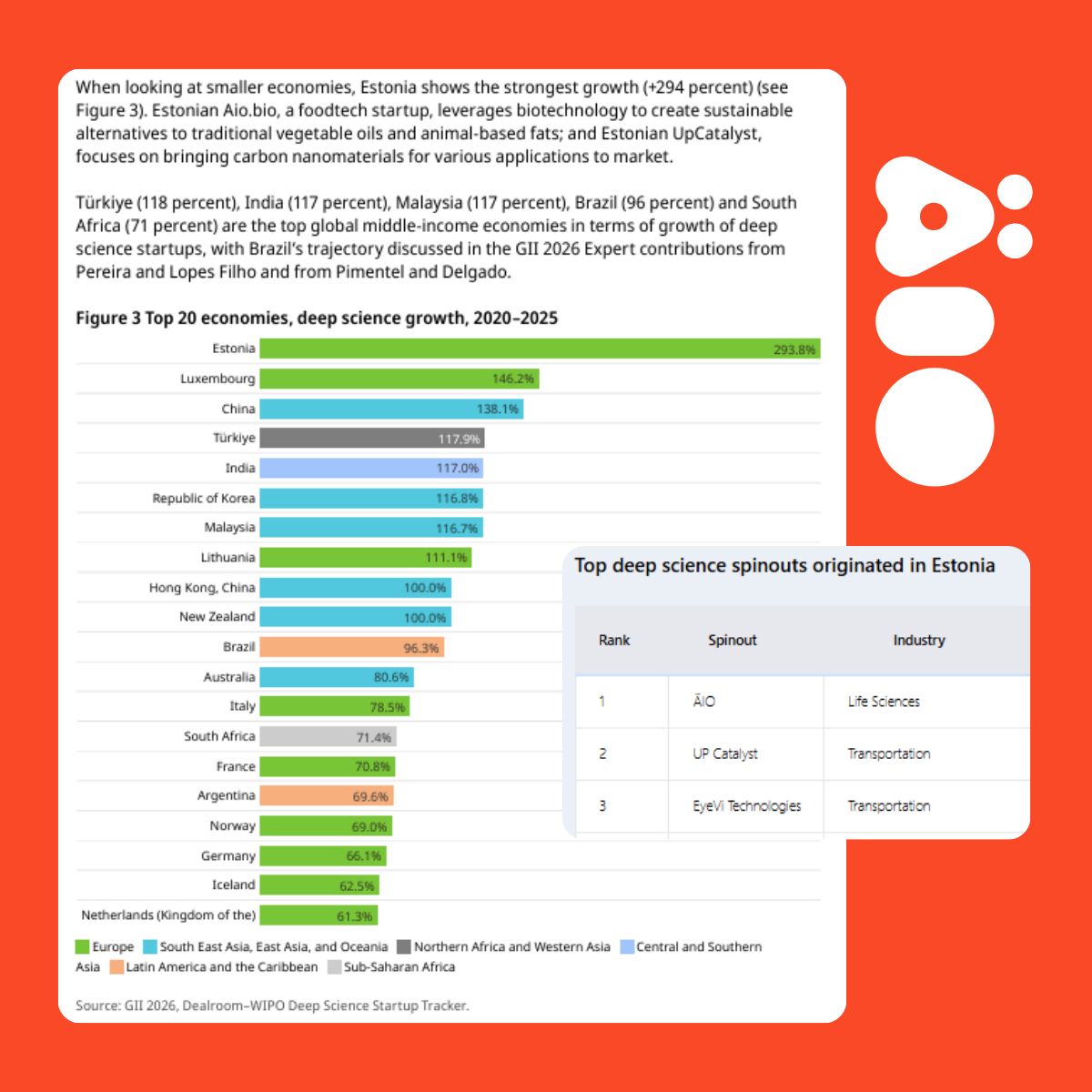
Estonia has recorded the fastest growth in deep-science startups among smaller economies, increasing by 294% between 2020 and 2025. The World Intellectual Property Organization (WIPO) highlights ÄIO as one of the Estonian companies illustrating this development in its Global Innovation Index 2026.
The places ÄIO’s journey from university research to industrial biotechnology within a much larger international story: the growing importance of science-based companies in bringing new technologies, products and industrial solutions to market.
What is the Global Innovation Index?
The Global Innovation Index (GII) is an annual international report published by the World Intellectual Property Organization (WIPO), a specialised agency of the United Nations. Since 2007, the GII has examined how countries develop, support and translate innovation into economic and societal value. The 2026 edition evaluates 139 economies using approximately 80 indicators, covering areas such as research and development, education, technology, intellectual property, business activity, investment and innovation outputs.
It is used by governments, policymakers, researchers and innovation organisations to compare national innovation systems, identify strengths and weaknesses, and inform future development strategies. The report examines how innovation is changing globally, where new technologies are emerging and what enables scientific discoveries to become commercially viable businesses.
Deep science: turning research into industry
The special theme of the 2026 Global Innovation Index is “Powering Entrepreneurs at the Frontier of Science.”
It explores how science-based startups and university spin-offs transform research breakthroughs into companies capable of developing, manufacturing and commercialising new technologies. Unlike many conventional startups, deep-science companies typically begin with years of research and experimental development, their technologies often require specialised infrastructure, laboratory validation, intellectual property protection, industrial-scale testing and significant capital before they can reach commercial markets, these companies operate across fields including biotechnology, advanced materials, robotics, semiconductors, energy and life sciences.
To better understand this growing sector, WIPO and Dealroom developed the Deep Science Startup Tracker, mapping more than 30,000 science-based startups and spin-offs founded since 2000. According to the report, these companies have a combined estimated valuation of USD 7.6 trillion, demonstrating the increasing economic significance of businesses built on scientific research. Life sciences remain one of the largest areas of deep-science entrepreneurship, while other fields, including advanced manufacturing and robotics, are expanding rapidly. The report also draws attention to a central challenge: developing a technology in the laboratory is only the beginning.
For deep-science companies, the transition from research to industrial production often requires years of development, investment, infrastructure and cooperation between universities, industry and investors. This is a challenge ÄIO knows well.
Estonia: a small country with rapidly growing deep-science entrepreneurship
Estonia stands out in the 2026 report for its exceptionally rapid growth in deep-science companies. According to WIPO, the number of deep-science startups and spin-offs in Estonia increased by 294% between 2020 and 2025 – the strongest growth among smaller economies included in the comparison. The Global Innovation Index also places Estonia 17th among 139 economies, maintaining its position among the world’s leading innovation economies.
For a country of approximately 1.4 million people, these results are significant.
Estonia is internationally recognised for its digital economy and technology entrepreneurship. The growth of deep science demonstrates another dimension of the country’s innovation ecosystem: the ability to develop businesses based on advanced scientific research and complex technologies.
The report highlights two Estonian companies as examples of this development:
- ÄIO, developing fermentation-derived alternatives to conventional vegetable oils and animal-based fats.
- UpCatalyst, developing carbon nanomaterials for industrial applications.
Although the companies work in different fields, they share an important characteristic: both are developing technologies that address industrial challenges through science-based innovation. Their inclusion illustrates how Estonia’s technology ecosystem is expanding beyond digital services and software into biotechnology, advanced materials and industrial production.
ÄIO: from scientific research to industrial biotechnology
ÄIO was founded in 2022 as a spin-off from TalTech, Tallinn University of Technology, building on research by co-founders Dr. Nemailla Bonturi and TalTech Professor Petri-Jaan Lahtvee. The scientific foundation of the company is microbial fermentation: using specialised microorganisms to produce valuable compounds from alternative carbon sources. ÄIO applies this technology to one of the world’s largest ingredient markets, fats and oils.
Conventional fats and oils are essential to cosmetics, food and numerous industrial applications. However, their production often relies on agricultural crops, extensive land use, water resources and supply chains exposed to climate and environmental pressures. ÄIO is developing another production route. Our proprietary fermentation technology converts low-value side streams from the food, agricultural and forestry industries into functional fats, oils and other valuable compounds. By producing these ingredients in controlled bioreactors, we aim to reduce dependence on conventional agricultural oil sources while providing consistent, traceable ingredients for industrial customers.
Since founding ÄIO, our team has progressed through several important development stages:
- Developing and validating the underlying fermentation technology.
- Scaling production from laboratory experiments to pilot and industrial-scale fermentation.
- Developing three commercially available cosmetic ingredients: FERMIRA™ RedOil, ZymaLipid Complex and Encapsulated Oil.
- Achieving COSMOS, NATRUE and Vegan certifications for our cosmetic ingredient portfolio.
- Establishing an international distribution network.
- Bringing fermentation-derived ingredients into commercial skincare products through collaborations with cosmetic brands.
- Continuing to develop the manufacturing processes and infrastructure required for larger-scale production.
Our ingredients are already used in finished cosmetic products available to consumers, demonstrating the transition from research and development to commercial application. Food applications are progressing through the relevant regulatory development pathways. This journey reflects the central theme of the WIPO report: turning scientific discoveries into technologies that can operate beyond the laboratory and serve real industrial markets.
Science meets entrepreneurship
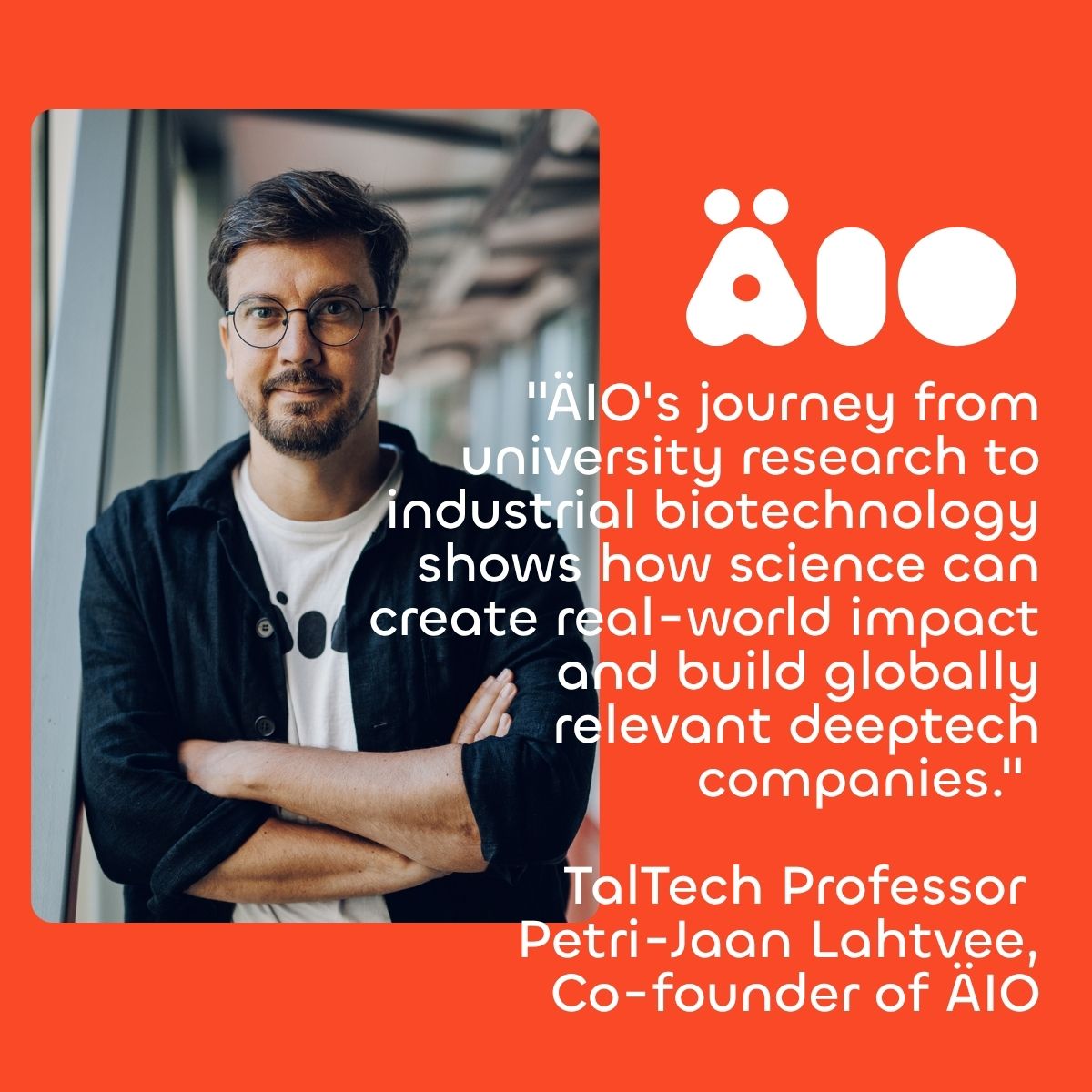
Commenting on ÄIO’s inclusion in the report, Professor Petri-Jaan Lahtvee, Co-founder of ÄIO and Professor at TalTech, said:
“ÄIO is a strong example of what can happen when science meets entrepreneurship. We started with university research, and today that science has moved into industrial production and global markets. It is great to see WIPO recognising this journey.”
The relationship between academic research and entrepreneurship is particularly important in industrial biotechnology. Scientific discoveries can establish what is technically possible. Building a company around those discoveries requires additional capabilities: process engineering, production scale-up, quality control, regulatory development, commercial partnerships and access to capital. In fermentation-based manufacturing, successful laboratory results must be translated into reliable production processes capable of delivering consistent quality, sufficient volumes and competitive economics. That transition requires cooperation between scientists, engineers, universities, research institutions, investors and industrial partners.
ÄIO’s development illustrates why these connections matter. The company originated in academic research, but bringing its technology to market has required building a multidisciplinary team, establishing manufacturing capabilities and working directly with customers and commercial partners.
Matter of being mentioned
The Global Innovation Index 2026 makes an important point: scientific innovation creates its greatest economic and societal value when research can move into real-world applications. That is the transition ÄIO is working to accelerate and we are proud to be highlighted alongside other Estonian deep-science companies and grateful to the universities, research partners, investors and innovation organisations helping build the ecosystem around us.
Being mentioned in the Global Innovation Index is different from receiving a product award or industry certification.
The WIPO report places the company within an international analysis of how scientific research is being transformed into businesses and industrial technologies. This recognition highlights the role of biotechnology in addressing established industrial needs. Fats and oils are not a new market, but the technologies used to produce them can evolve. It also demonstrates the importance of university spin-offs in bringing scientific knowledge into commercial use and draws international attention to Estonia’s growing deep-science ecosystem and the companies developing technologies with global applications. Also, it reinforces the importance of supporting deep-science companies beyond the research stage – particularly as they move into manufacturing, commercial production and international markets.
These steps that determine whether promising scientific innovations can become practical industrial solutions.
The next stage is about producing more, improving manufacturing economics and making fermentation-derived ingredients available to a larger number of industrial customers. It requires continued advances in bioprocess engineering, production efficiency, digitalisation and industrial collaboration.
It also requires investment suited to the development timelines and infrastructure needs of industrial biotechnology.
Read more:
- WIPO Global Innovation Index 2026 – Special Theme: Powering Entrepreneurs at the Frontier of Science
- Estonia’s Global Innovation Index 2026 Profile
- Estonian Patent Office: Estonia’s Deep-Science Growth
- Learn more about ÄIO